
TWIN TOWERS
Click to listen
TWIN TOWERS
1. Overview of the Champa Kingdom and Cham Towers in Gia Lai
Champa was a kingdom established along the central coast of Vietnam in the 2nd century AD (around 192). Its territory stretched from today’s Quang Tri Province down to Lam Dong Province and expanded into the Central Highlands.
Due to historical changes, the Cham people established their capitals in different locations:
-
Sinhapura Period (Lâm Ấp): From the 2nd century AD to the mid-8th century, the capital Sinhapura (Lion City) was located in the Amaravati region (Tra Kieu Village, Duy Xuyen Commune, present-day Da Nang City).
-
Virapura Period (Hoàn Vương): From the mid-8th to the mid-9th century, the capital was in the Panduranga region (present-day Khanh Hoa Province) in the southern part of Champa.
-
Indrapura Period (Chiêm Thành): From the mid-9th to the late 10th century, the capital was in the northern Cham region (Dong Duong Village, present-day Da Nang City).
-
Vijaya Period: From the late 10th century until 1471, the capital of Champa was Vijaya (located in present-day Gia Lai Province).
Thus, Gia Lai served as the capital of the Champa Kingdom for five centuries. During this time, the Cham people left behind many valuable cultural heritages, including eight groups of towers with a total of 14 towers. With these eight remaining Cham tower complexes, Gia Lai is proud to be the region that preserves the largest number of Cham towers. Unlike in some areas, Cham towers in Gia Lai are scattered across different sites, mostly surrounding the ancient capital of Vijaya.
2. Structure of the Twin Towers Complex
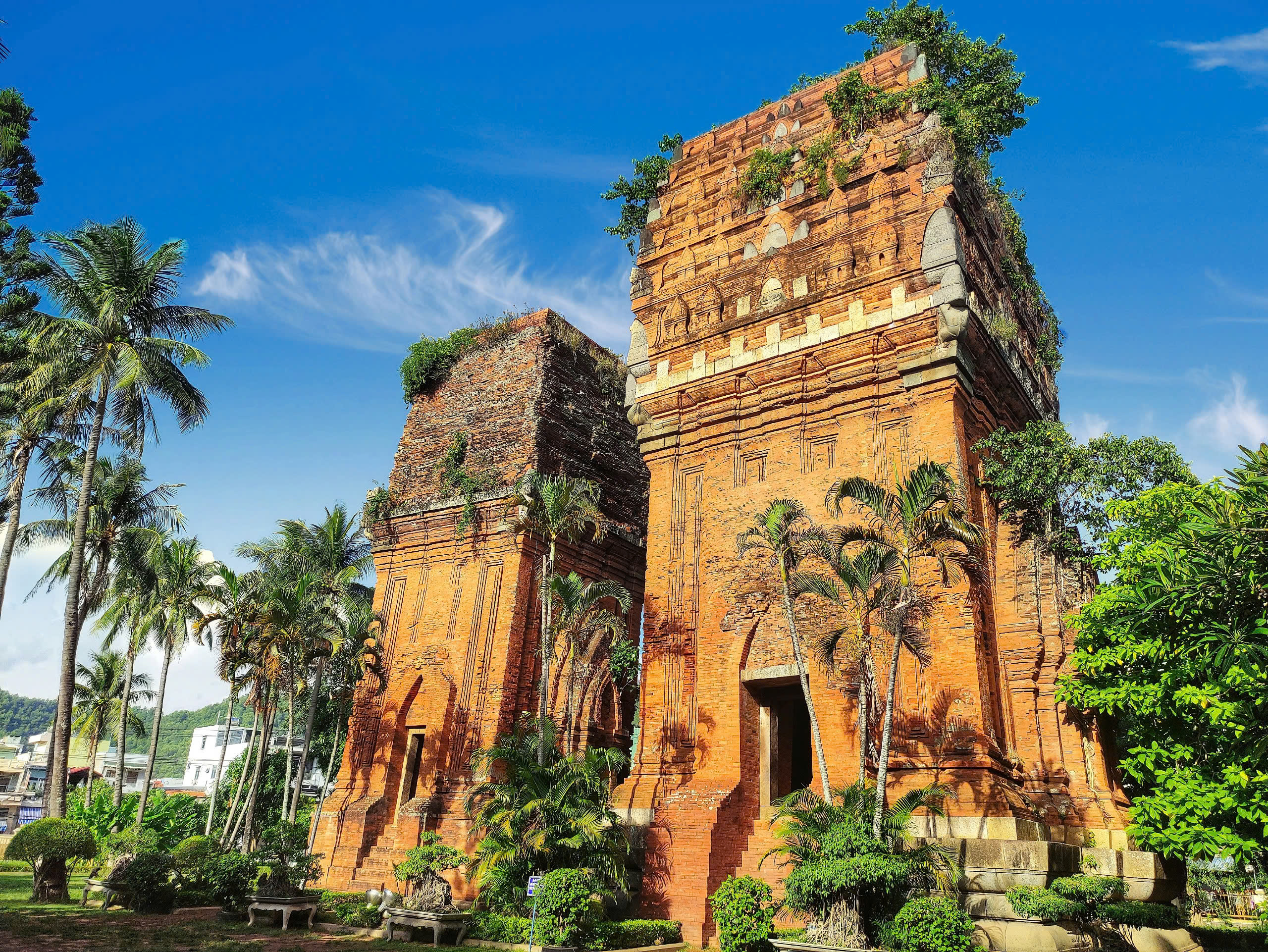
As the name suggests, the Twin Towers site features two towers standing side by side. The northern tower is taller and less damaged than the southern one. The northern tower now stands at nearly 22 meters, while the southern one is over 17 meters tall.
Cham tower complexes usually consist of a single tower, a group of three towers, or multiple towers. The Twin Towers, however, exist as a pair. This raises the question among researchers whether a third tower once existed. In the 1990s, provincial museum staff carried out a survey and found carved stone blocks scattered around the site, some of which were similar to those used for the foundations and upper tiers of the two existing towers. Based on this, researchers suggest that a third tower may have been planned but never completed. To this day, the mystery remains unresolved.
3. Dating and Architectural Style
Based on their shape, structure, carvings, and building materials, researchers classify the Twin Towers as belonging to the Binh Dinh architectural style, dating from the late 12th to early 13th century.
The Twin Towers retain traditional Cham tower features: a square body, a main entrance facing east, and three false doors on the remaining sides. However, they also reflect the distinct Binh Dinh Cham style with large block forms, pointed arch-shaped entrances and false doors, tall vertical pilasters without decorative motifs, and smooth wall surfaces.
What makes the Twin Towers unique is their unusual design: a square base with a curved roof structure. Unlike other Cham towers that taper in three tiers, the Twin Towers feature a system of false tiers. Each corner of these tiers is adorned with figures of Garuda, the mythical bird-man, depicted with bent legs bracing against the walls, arms stretched upwards as if supporting the heavy upper tiers, and a fierce, grim face. Additionally, there are reliefs of mythical animals influenced by Khmer art of the 12th–13th centuries.
Among the ancient Cham towers in Gia Lai, the Twin Towers stand out as the most heavily influenced by Khmer architecture. This is evident in their overall form, decorative motifs, and the extensive use of stone. For example, the eastern doorway features a sandstone lintel, the base walls are supported by large stone blocks carved as a giant lotus pedestal, and the reliefs on the roof are also made of stone.
The Khmer influence is understandable: during the 12th–13th centuries, Champa and the Khmer Empire were locked in constant warfare. Most of these events occurred in the Vijaya region—present-day Gia Lai—the Cham capital at the time. As a result, the influence of Khmer art on Cham architecture and sculpture in Gia Lai is especially pronounced.
Ý kiến bạn đọc
- Đang truy cập12
- Hôm nay55
- Tháng hiện tại938
- Tổng lượt truy cập62,624