
DUONG LONG TOWER
Click to listen:
DUONG LONG TOWER
General Introduction to Duong Long Towers
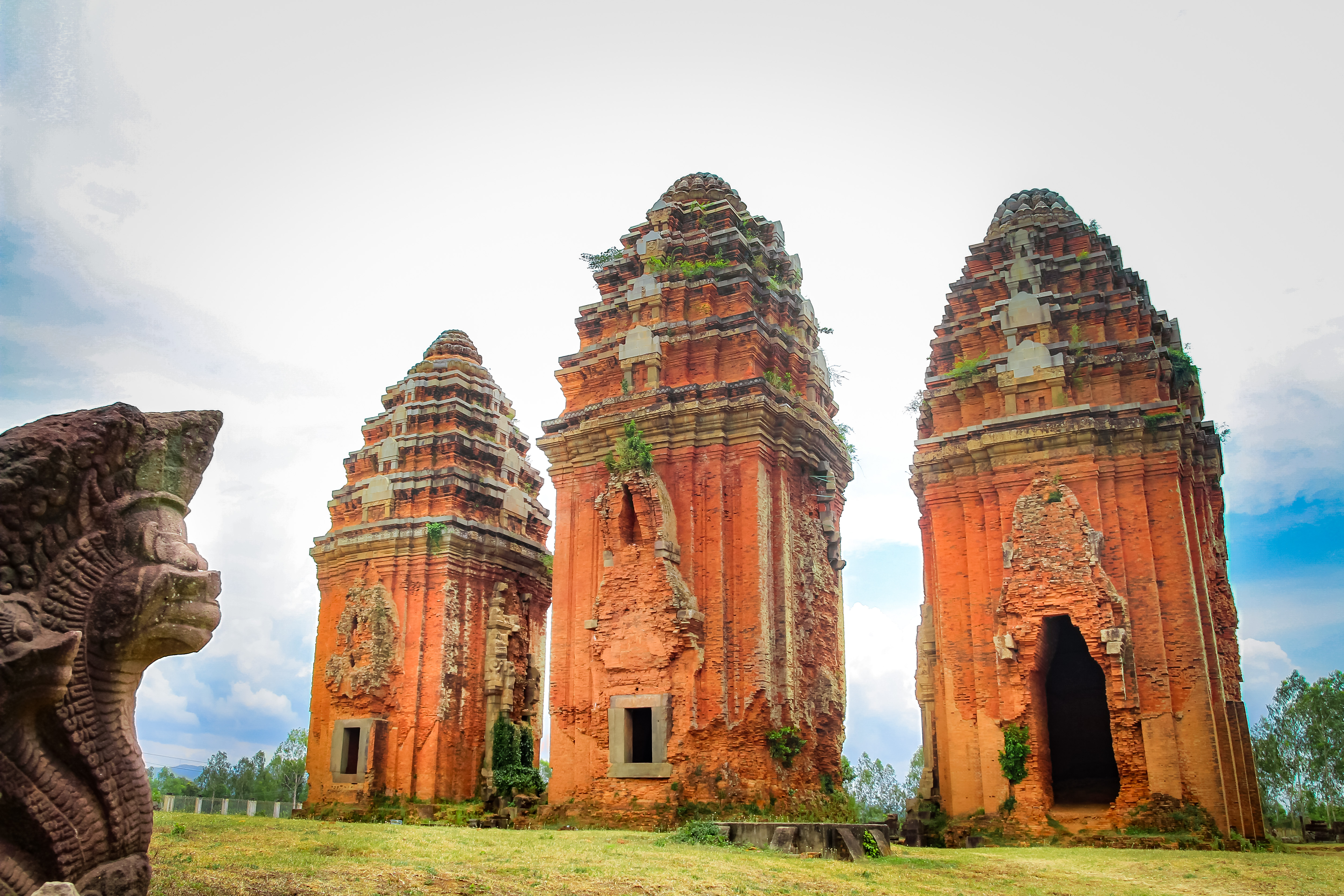
We are now visiting one of the most intact Cham architectural complexes still preserved in Central Vietnam. This is the tallest surviving brick tower complex in Southeast Asia: the central tower rises to 39 meters, while the two side towers measure 32 and 33 meters respectively.
The complex was recognized as a Special National Monument by the Prime Minister of Vietnam on December 23, 2015. French researchers once referred to it as Tour d’Ivoire (Ivory Towers). Local people previously called it Binh An or An Chanh Towers, after the names of the surrounding area. However, Duong Long has become the most common and officially recognized name today.
Like most Cham towers in Gia Lai, Duong Long Towers bear clear influence from Khmer architecture. In form, structure, and decorative motifs, the towers reflect Khmer features, particularly the practice of placing temples on high hills following the Khmer “temple–mountain” style, and the extensive use of stone in construction, as can still be seen here. Based on building materials, architectural lines, and sculptures, researchers date the Duong Long complex to the 12th–13th centuries.
All three towers share a similar form and are aligned along a north–south axis, with their main entrances facing east. Their differences are expressed in the sculptural decorations, each stroke showcasing the artistry of Cham craftsmen of the time.
The North Tower
In front of us stands the northern tower of the Duong Long complex. Compared to the other two, this tower has suffered the most severe damage from both time and human activity.
Its body has been deeply excavated and was reinforced in the 1980s. The tower stands about 32 meters tall. Despite being the most damaged of the three, it still preserves the most intact false door on its southern side, adorned with extremely elaborate and refined stone carvings. The surviving elements reveal that an enormous amount of stone was used here, with diverse sculptural themes displaying the finesse and sophistication of ancient Cham artisans.
Fortunately, the base band beneath this false door remains intact. Though the stone blocks appear only to have been assembled, without detailed carving, they leave us with the image of a nearly complete false door — from its foundation up to its arched top, except for the missing apex. This is considered one of the most intact, beautiful, and valuable stone sculptures not only of Duong Long but also among all surviving ancient Cham towers.
The Central Tower
The central tower rises about 39 meters, making it the tallest brick tower in Southeast Asia today.
One of the most outstanding and valuable artistic features of Duong Long is that nearly all decorative themes are carved in stone: the plinth, cornices, false doors, and entrances. No other surviving Cham tower preserves as many stone sculptures as Duong Long.
As we observe, the stone bands are meticulously carved with motifs such as alternating upward and downward lotus petals. The most distinctive decoration is the rounded, polished female breasts clasping the base, symbolizing the goddess Uroja. Above are vivid carvings of the Kala face and the single-headed Naga serpent.
The carving techniques demonstrate the Cham artisans’ mastery: a blend of traditional Cham softness, simplicity, and rustic forms with Khmer–Angkor techniques of deep relief carving, producing intricate swirling patterns and elaborate compositions. Notably, some decorative bands remain unfinished, indicating that carving was carried out after the stone blocks had been installed. Why these carvings were left incomplete remains an unanswered question.
The South Tower
The southern tower stands about 33 meters tall, similar in size to the northern tower. Like the others, its cornices are built entirely of sandstone, running continuously around the four façades, decorated with Gajashimha (lion-bodied elephant heads) and rows of raised circular dots.
The sandstone main doorway still survives. The northern false door shows a three-part structure made of large, solid stone blocks, though most of its arch has collapsed. Only fragments remain: reliefs of lions and a five-headed Naga at the corners of the arch, and depictions of lions and goats along the bands.
Compared with the central tower, the base band of the south tower is simpler, focusing more on form than detailed ornamentation. The most beautiful feature is the Garuda figures carved at the corners of the base. They are depicted standing with chest thrust forward, eyes wide, cheeks full, and arms raised as if lifting the entire massive tower above.
Two Western Structures
Archaeological excavations in 2008 uncovered the foundations of two additional structures to the west of the main towers.
According to archaeologists, these were open, low-walled structures built in the same Cham architectural tradition, using laterite foundations like the main towers. They likely formed part of the overall Duong Long complex and may even predate the three principal towers.
Though largely destroyed, these structures left behind a highly symbolic Cham religious object: a Yoni, one part of the Linga–Yoni ensemble representing fertility worship in Cham belief. Sadly, the upper component — either a Linga or a Shiva statue — is no longer present. The Linga–Yoni symbolizes the Hindu god Shiva, affirming his presence in the rituals at Duong Long.
Religious Function and Cultural Significance
In Cham architecture, tower groups arranged in three parallel structures typically honored the three supreme Hindu deities: Brahma, Vishnu, and Shiva. The northern tower was dedicated to Brahma, the central tower to Shiva, and the southern tower to Vishnu.
Among the many stone artifacts unearthed at Duong Long are reliefs depicting Brahma (distinguished by three heads, eight arms, and attributes such as daggers and lotuses) and Garuda, the divine mount of Vishnu. These finds, together with the tri-tower structure, confirm that Duong Long was a Hindu temple complex dedicated to Brahma, Vishnu, and Shiva.
Archaeological discoveries of surrounding foundations also clarify earlier hypotheses: Duong Long was not limited to the three surviving towers but was once a vast architectural complex with multiple subsidiary structures.
Ý kiến bạn đọc
- Đang truy cập15
- Hôm nay55
- Tháng hiện tại941
- Tổng lượt truy cập62,627