
BINH LAM TOWER
Click to listen:
BINH LAM TOWER
General Introduction to Binh Lam Tower
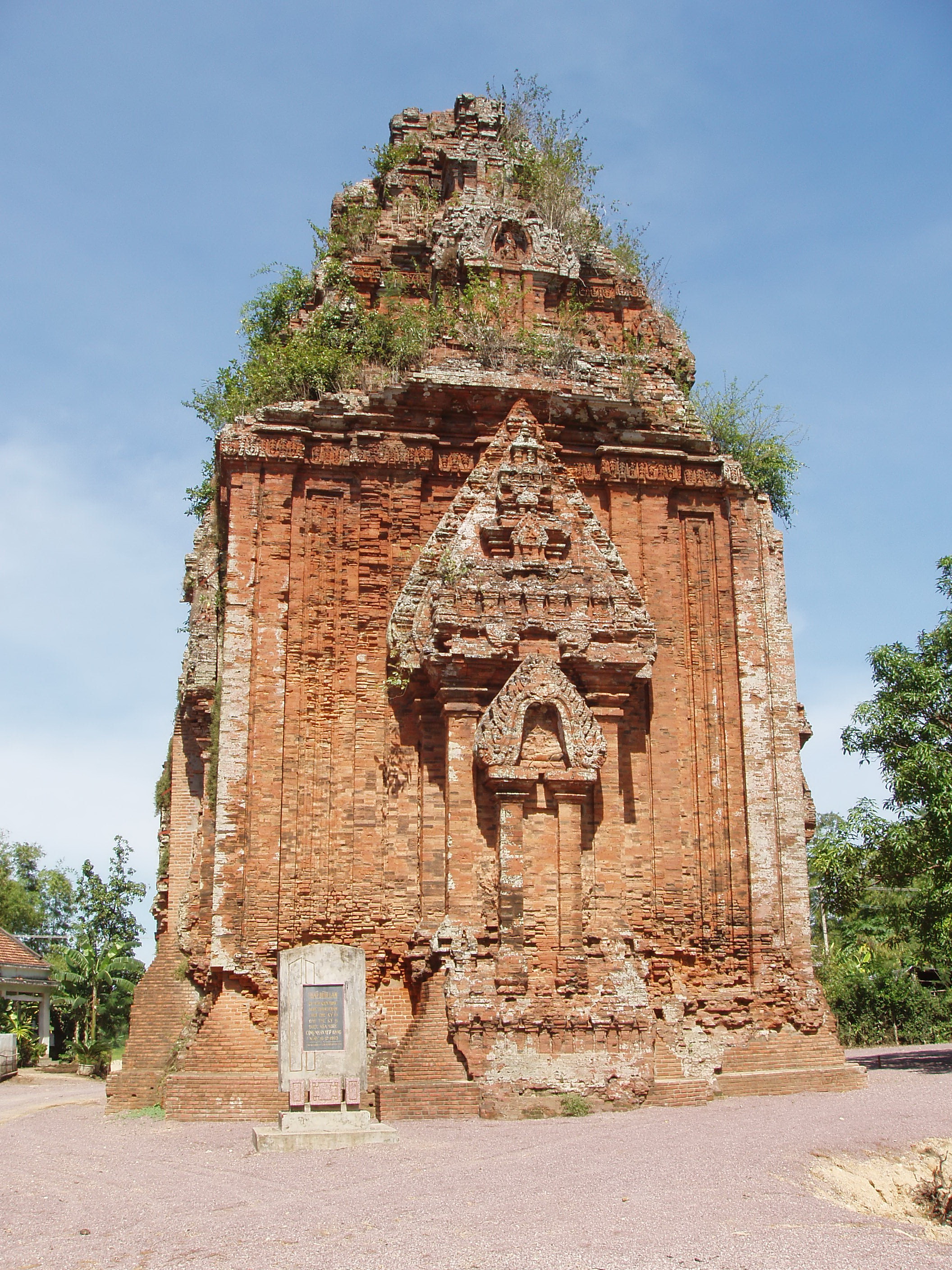
Binh Lam Tower is one of the earliest Champa architectural monuments in Gia Lai, built in the first half of the 11th century. The tower is located in Binh Lam Hamlet, Tuy Phuoc Dong Commune, Gia Lai Province. The tower was named after the local area where it was erected, hence the name Binh Lam Tower.
Unlike most ancient Champa towers in Gia Lai or the Cham towers in the Binh Dinh style that were typically built on high hilltops, Binh Lam Tower stands on the plain, blending harmoniously with the surrounding natural landscape and local community. For this reason, the tower does not proudly dominate the skyline like others; instead, it is gently hidden behind peaceful and poetic village bamboo groves. Only after passing through these bamboo hedges and entering the village does the ancient Champa tower reveal its full beauty. Rising to about 20 meters, the massive structure still radiates a graceful charm through its reddish brickwork despite the passage of more than a thousand years.
Researchers consider Binh Lam Tower to be among the most architecturally complete Champa towers still preserved today. The proportions of its structural elements are harmonious, leaving viewers with a sense of calm and balance. The body of the tower is not low and heavy but appropriately proportioned in relation to the upper tiers, which gradually recede in an orderly manner.
Architectural Style of Binh Lam Tower
Architecturally, many details of Binh Lam Tower recall features of 10th-century Cham towers in the My Son A1 style, such as the structure of pilasters on the walls, the decoration of false doors, and the niches (kham).
However, at Binh Lam, the grooves of the pilasters no longer divide them into paired columns; the pilasters are no longer fully. covered with decorative motifs; the ornamental bands between pilasters have disappeared; and the niches depicting human figures between pilasters are absent. Therefore, compared with Cham towers of the My Son A1 style, Binh Lam Tower is less graceful, delicate, and ornate. Yet the absence of dense wall decoration gives its architectural elements a stronger, sturdier appearance and helps emphasize the main sculptural motifs.
In this sense, Binh Lam Tower retains the elegance of 10th-century Champa architecture while simultaneously foreshadowing a new style. It displays the robustness and solidity characteristic of Cham towers in the Binh Dinh style, marking a transitional stage from the refined and graceful My Son (Quang Nam) style to the grand and vigorous Binh Dinh style.
Function of Binh Lam Tower
Which deity was once worshiped at Binh Lam Tower, or whether it served another civil purpose, remains unanswered, as no cult objects survive inside the tower today.
However, within the nearby Thien Truc Pagoda, a Vietnamese temple adjacent to the tower, two large Cham stone sculptures have been discovered: a Linga and a Garuda, both dating from the same period as Binh Lam Tower. Based on this, researchers suggest that these sculptures originally belonged to the tower and thus infer that Binh Lam Tower was once a sanctuary dedicated to the Linga of the Hindu god Shiva.
Binh Lam Tower was officially recognized as a national architectural and artistic monument in 1993. Today, it has been restored and conserved, partially recovering its original beauty and significance as one of the remarkable relics of Champa culture
Ý kiến bạn đọc
- Đang truy cập10
- Hôm nay89
- Tháng hiện tại815
- Tổng lượt truy cập62,501