
The Nui Ba Revolutionary Base
Click to listen:
The Nui Ba Revolutionary Base
The Nui Ba Revolutionary Base, both a historical and scenic site, is located in the southeast of Gia Lai Province, spanning four communes: Ngo May, Cat Tien, De Gi, and Hoa Hoi.
Nguyen dynasty historians referred to Nui Ba as Pho Nghinh Dai Son. Nui Ba is not a single mountain but a range of 66 peaks of varying heights. Between these peaks lie lush forests and thousands of streams, making the landscape majestic and diverse, home to rare animal species.
Among its lofty summits are Hon Hoe in the southeast, Hon Hang Rai in the northeast, and Hon Chuong in the west—the highest, rising over 700 meters above sea level. From afar, Hon Chuong resembles an inverted bell, and atop it lie the ruins of an ancient Cham tower known locally as Thap Hon Chuong. Surrounding Nui Ba are other well-known landmarks such as Hon Vong Phu—with the legend of a woman turned to stone while waiting for her husband—Linh Phong Pagoda, associated with the tale of Ong Nui, renowned for its sacredness, perched halfway up the mountain amid a sea of clouds.
With the sea to the east and National Highway 1 to the west, Nui Ba was a strategically convenient site for both land and water transportation. Its rugged terrain and numerous natural caves made it an ideal revolutionary base during the resistance against the Americans. It served as the headquarters of the Provincial Party Committee, provincial government bodies, provincial armed forces, the Quy Nhon Town Party Committee, and the district committees of An Nhon, Tuy Phuoc, and Phu Cat.
From here, the Provincial Party Committee directed resistance operations, organized training courses for armed forces and revolutionary cadres, and launched major offensives and uprisings, including the “Eastern Uprising” (1964) and the Spring Offensive of Mau Than (1968). The devastation of war in this area was etched into people’s memory in a poignant verse:
“Khu Đông gạo trắng nước trong
Nhưng ai đến đó không mong trở về.”
(“Eastern Zone, rice is white, water is pure,
But whoever goes there does not hope to return.”)
In the spring of 1975, Nui Ba again witnessed heroic moments. At Trang Bang in Son Rai, all provincial armed units, together with Quy Nhon Town and district forces, held a solemn oath-taking ceremony under the slogans:
-
“With the spirit of Mau Than,”
-
“March forth like Nguyen Hue,”
-
“Destroy completely as at Dien Bien.”
With such determination, our army and people liberated Quy Nhon Town on March 31, 1975, concluding the victorious resistance war against the United States in Binh Dinh Province (today part of Gia Lai).
The Nui Ba Revolutionary Base can be likened to a benevolent mother, sheltering and nurturing the revolutionary forces throughout the arduous years of war. It bears witness to the indomitable spirit of cadres, soldiers, and the people of Binh Dinh. Places such as Area 10, the Eastern Zone Field Hospital, Lotus Hill, Vinh Hoi, Ho Nhay, Dong Rung Cave, and Son Rai remain unforgettable to those who lived and fought there.
With its imposing mountains, natural caves, and breathtaking scenery, Nui Ba is also a magnificent natural attraction of Gia Lai Province. The site was recognized as a National Historic and Scenic Monument in 1994, with 22 associated relics linked to the revolutionary struggle and resistance against the United States.
Ladies and gentlemen,
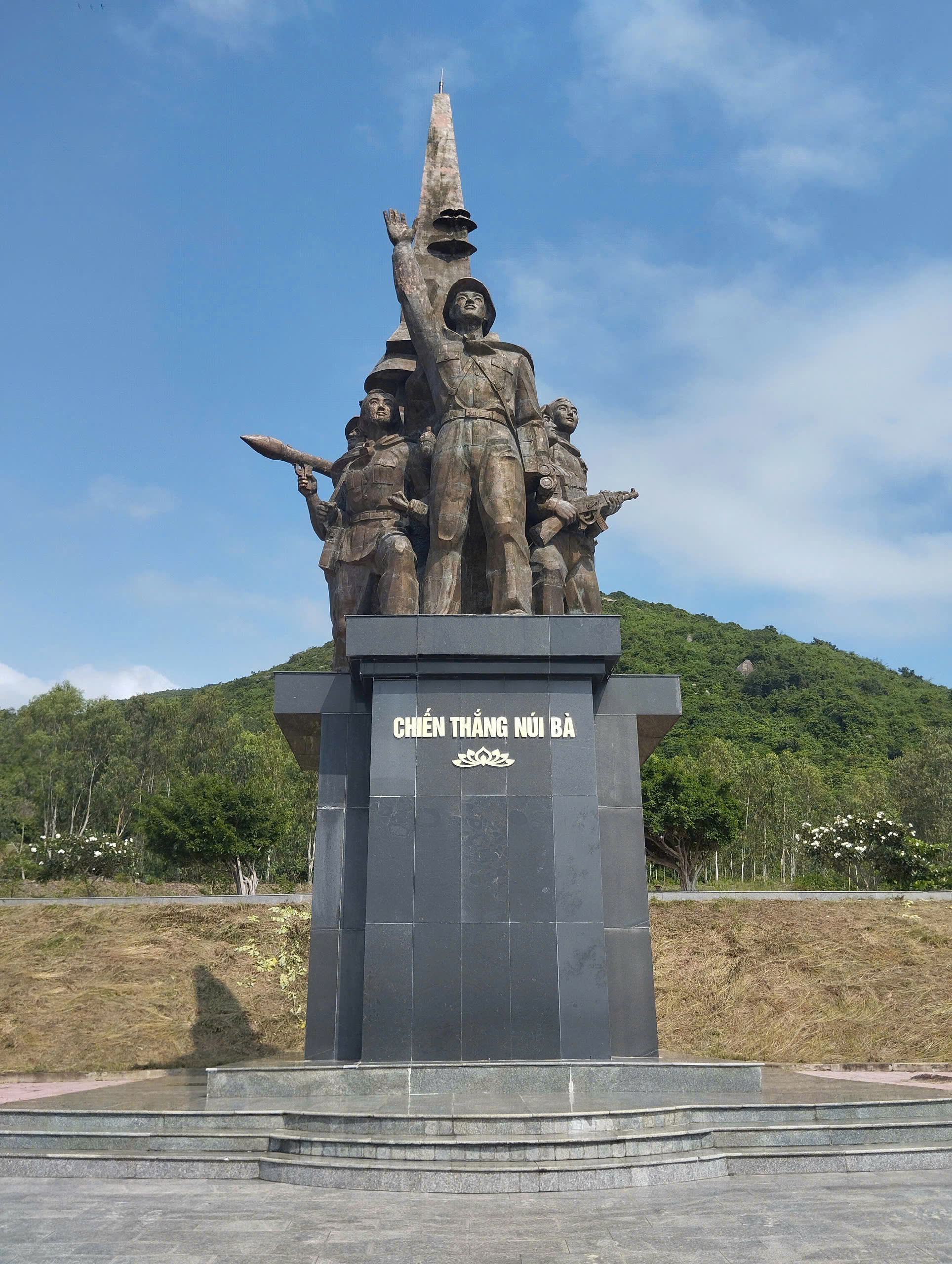
At the foot of Nui Ba stands the Victory Monument, erected at the heart of the revolutionary base. The statue, about 18 meters high, is built of reinforced concrete coated with bronze. It honors the heroes, martyrs, and compatriots who sacrificed their lives for national liberation, commemorating the glorious victories of the armed forces and people of Gia Lai during the resistance war, and serves as a source of education for present and future generations.
Standing before the Nui Ba Victory Monument, we cannot help but feel deep pride in the heroic struggle of our forefathers and greater love for this majestic landscape, sanctified by the sacrifices of loyal sons and daughters, now a symbol of the pride and spirit of Gia Lai.
Ý kiến bạn đọc
- Đang truy cập22
- Hôm nay101
- Tháng hiện tại827
- Tổng lượt truy cập62,513